
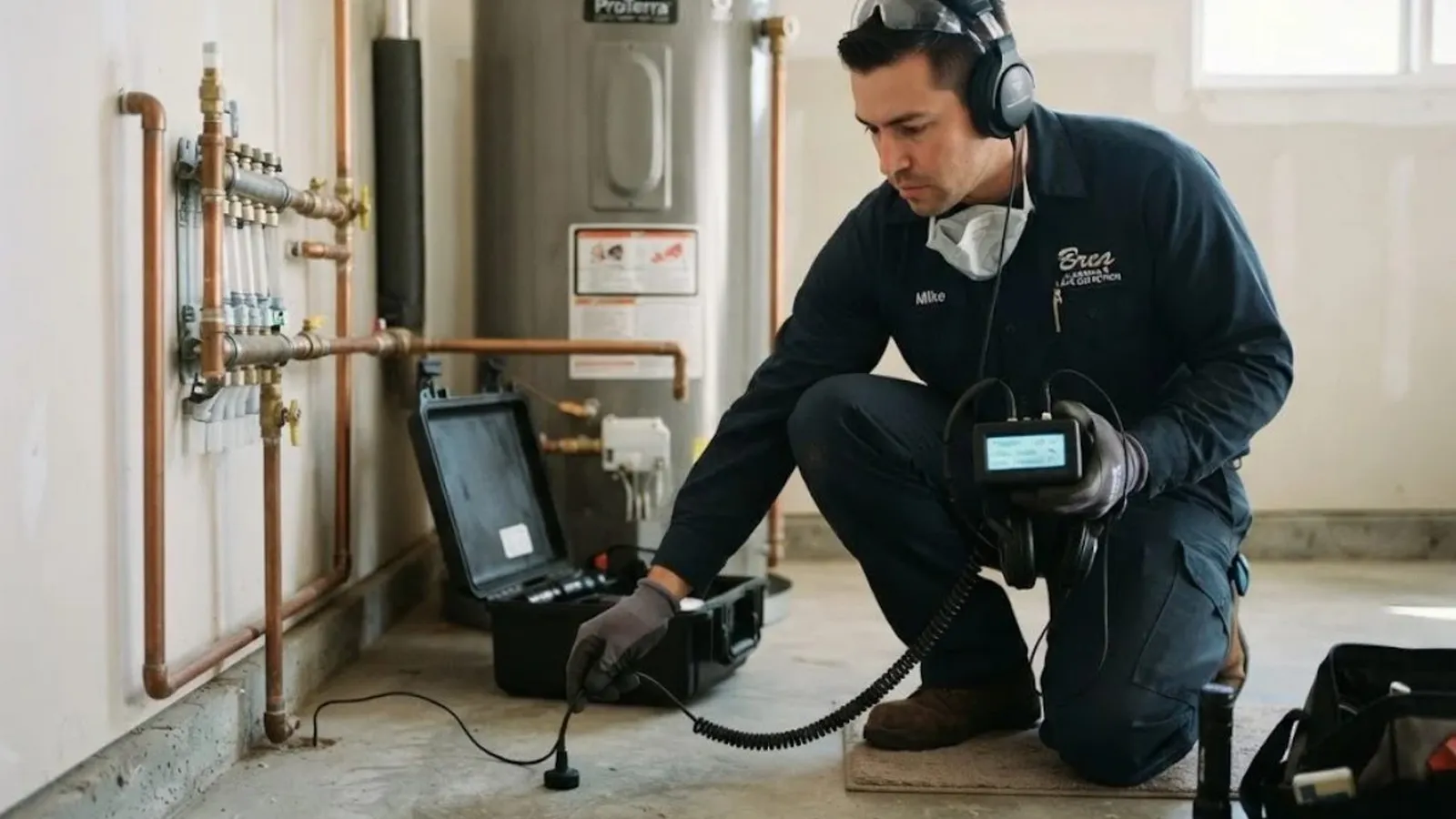
What to do while you wait for the plumber
Steps that limit the damage
- Close the main water valve if water is visibly flowing.
- Do not use the fixtures near a stain or a damp wall.
- Put a bucket under any drip and move valuables out of the area.
- Do not touch outlets or switches near wet drywall or flooring.
- Photograph the stain, the meter and the water bill for your records.
Start with your symptom
You rarely call for leak detection because you know where the leak is. You call because of a symptom. The list below matches common symptoms to the first check a plumber makes.
| What you notice | First suspect | First check |
|---|---|---|
| Water bill climbed with no change in habits | Toilet, hidden supply leak or service line | Meter test with every fixture off |
| Meter dial moves with everything off | Leak between the meter and the fixtures | Isolate by closing the main valve and watching |
| Warm spot on a floor | Hot water line under a slab or floor | Thermal imaging and listening |
| Stain growing on a ceiling | Supply or drain pipe above, or a roof leak | Moisture meter, then pressure test |
| Low water pressure in the whole house | Leak on the main line or a failing valve | Pressure gauge at an outdoor spigot |
| Wet patch in the yard | Buried service line or irrigation | Listening gear along the line |
Do the meter test yourself
Shut off every faucet and appliance that uses water, and make sure no one flushes a toilet. Find your water meter and write down the reading or watch the small leak indicator on the dial. Wait about 30 minutes with nothing running, then check again.
If the number moved or the indicator keeps turning, water is escaping somewhere. Close the main valve inside the house and look again. If the meter stops, the leak is inside the house or on the line after the valve. If it keeps turning with the main closed, the leak is between the meter and your house.
Ceiling, wall and attic leaks
A stain on drywall shows where water ended up and not where it began. Water travels along framing and runs down pipes before it shows. A plumber uses a moisture meter and a thermal camera to trace it back, then a pressure test to confirm which line leaks.
If the stain appears after rain, a roof or window leak is the cause and a roofer is the right call. If it grows when the shower runs or after a flush, the supply or drain line above it is the suspect. Turn off the water to the area and put a bucket under any drip while you wait.
Meter still turning with every tap off? Call and book a leak check.
Call (732) 466-1098Under the house, the slab and the crawlspace
Leaks in crawlspaces and basement floors are easier to reach, but they hide in insulation and damp soil. Look for pooled water, mold odor and rotted wood. A leak under a concrete slab may announce itself with a warm spot on the floor, the sound of running water or a meter that moves with all fixtures closed.
Slab leaks are located by listening to the pipe, thermal imaging and sometimes tracer gas. We treat them as part of leak detection. The repair choice depends on where the pipe runs and how many leaks it has, and sometimes repiping a line is more sensible than spot patching.
Buried lines, yard leaks and irrigation
The water service line runs from the meter or curb to your house, and a leak on it can saturate the yard without any stain indoors. A soggy lawn on a dry day, a new green strip or a drop in pressure are the usual clues. A plumber listens along the line with a ground microphone and marks the loudest point.
Sprinkler systems add their own buried pipes and valves. A zone that stays wet, a valve box full of water or a rising bill during watering season points to the irrigation side. If the leak is on the main service line, read our water line repair page for options.
Pools and spas, in one paragraph
If you have a pool or spa, a water level that drops faster than evaporation explains can mean a leak in the shell or the plumbing. The bucket test, with a marked bucket floating in the pool, helps tell evaporation from leakage. A plumber can pressure-test the pool lines to find out whether the problem is in the pipes.
How hard water and bay-side soil change what we see
Middletown's water comes from New Jersey American Water's Coastal North system, where total hardness ran 72 to 140 ppm in 2023. Mineral scale can crust around slow weeps and hide small drips for years. Homes in Port Monmouth, Belford and Leonardo, where Sandy flooded dozens of streets in October 2012, may have rebuilt plumbing, so any leak check there can include lines that were replaced after the storm.
If a leak is behind a wall in a historic home near Middletown Village, access is part of the plan. We open as little as possible, and we tell you what we expect to find before cutting.
Any repair that follows detection is done to the state plumbing standard, the National Standard Plumbing Code 2021, adopted at N.J.A.C. 5:23-3.15.
From detection to repair
Once a leak is found, the fix depends on the pipe, whether it is a burst pipe repair or a buried line that needs water line repair. Detection visits are available in Red Bank as well as across the township.
What changes the price of leak detection
We give a clear price before work starts.
Insurance note: most policies cover sudden leaks but may not pay for the pipe itself or for gradual damage. Document everything with photos and dates and call your insurer early.
Questions we hear from Middletown homeowners
Yes. Dispatch is open 24 hours a day. If water is actively flowing, shut off the main valve and call, then move valuables away from the wet area.
Run the meter test with all fixtures off. A moving dial is a leak. Also check toilets, since a running toilet can waste a lot of water without making noise.
Often yes. Moisture meters, thermal cameras and listening equipment narrow the location so access can be small. Some leaks still need an opening to confirm.
Signs include warm floor spots, the sound of running water and a moving meter with everything off. A plumber can confirm with listening and imaging before recommending a repair.
Yes. A drain leak shows up as a stain that grows when a fixture drains. A camera pass or a fill-and-watch test can confirm it. See sewer camera inspection.